
If you or someone in your family has federal student loans in the United States — or you're an international student weighing US graduate programs — there's a set of rule changes that quietly reshaped the entire system this year. Since July 1, 2026, the way Americans borrow for college and pay that money back looks noticeably different than it did before. Here's a clear, no-jargon walkthrough of what actually changed.
The direct answer: what changed on July 1, 2026?
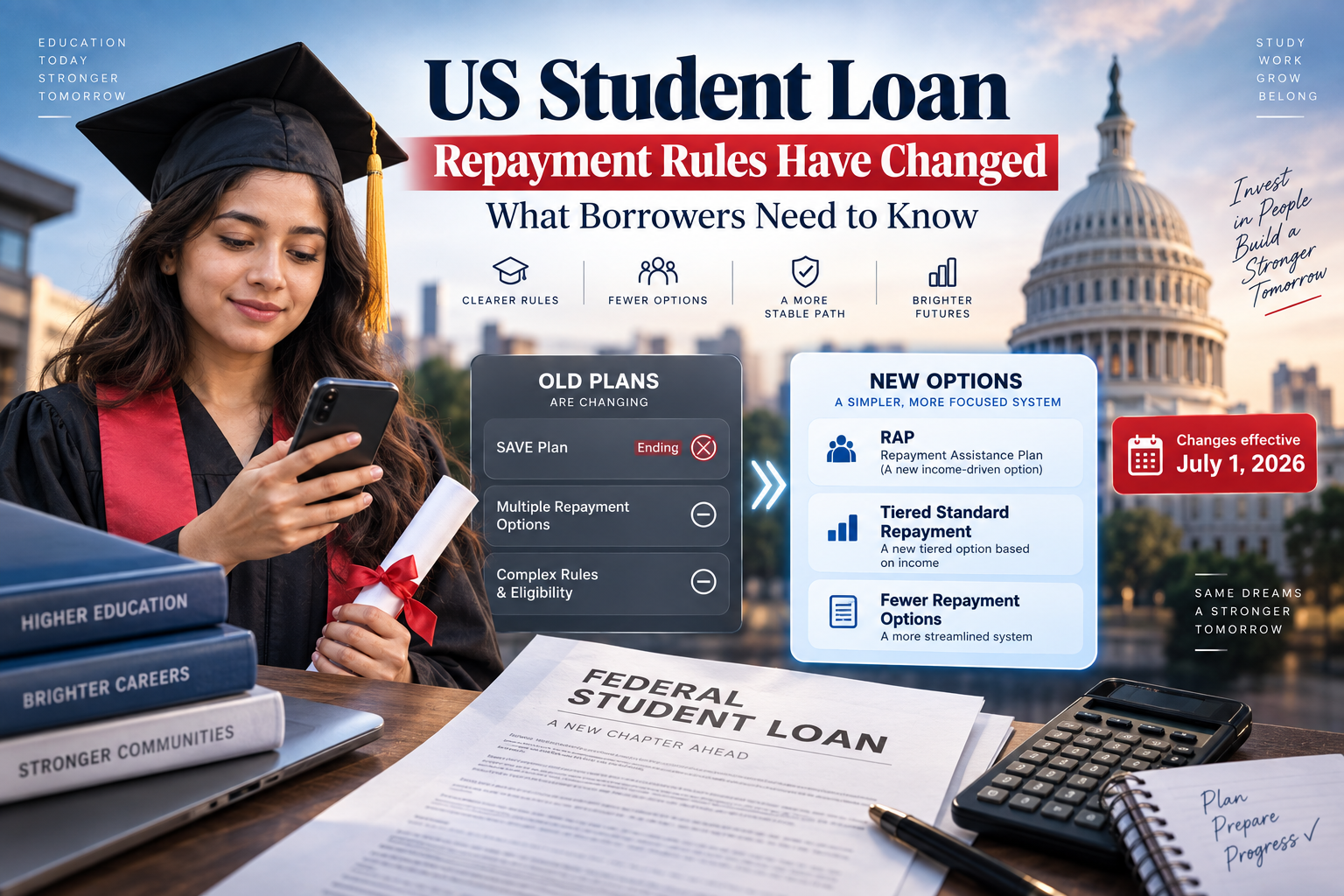
The US federal student loan system moved from a wide menu of repayment plans down to essentially two main options for new borrowers: a Tiered Standard Repayment Plan and a new Repayment Assistance Plan (RAP). At the same time, new borrowing caps came into effect — including a $100,000 lifetime cap for graduate student loans — and the Grad PLUS loan program, which previously let graduate students borrow up to their full cost of attendance, was eliminated for loans taken out after that date.
Where these changes came from
These reforms stem from a federal law often referred to as the "One Big Beautiful Bill Act" (also referenced in some official materials as the Working Families Tax Cuts Act), which the US Department of Education finalized into regulation on April 30, 2026, after a public comment period that drew over 80,000 responses. Most provisions took effect July 1, 2026, with a few related to loan rehabilitation and forbearance following in July 2027, and the full phase-out of certain older repayment plans completing by July 2028.
The two new repayment plans, explained simply
1. Tiered Standard Repayment Plan This is a fixed monthly payment plan, but the repayment term now depends on how much you borrowed — anywhere from 10 to 25 years. Borrowers with larger balances get longer repayment windows, which lowers the monthly payment but extends how long the loan stays outstanding.
2. Repayment Assistance Plan (RAP) This is the new income-driven option, replacing the patchwork of income-driven repayment plans that existed before. Under RAP, monthly payments are calculated as roughly 1% to 10% of a borrower's adjusted gross income, with a minimum payment of $10 a month for those with very low or no income.
What's happening to the older repayment plans
This is the part causing the most confusion for existing borrowers, so it's worth laying out clearly:
- If you borrowed before July 1, 2026: You can generally keep your current plan — including the standard plan, Income-Based Repayment (IBR), or graduated/extended plans — for now, or opt into the new RAP plan if it works out better for you.
- The SAVE plan is being phased out: The Saving on a Valuable Education (SAVE) plan, an income-driven repayment option introduced under the Biden administration, was blocked by federal courts and is being wound down. Borrowers currently enrolled in SAVE are being notified they must choose a new plan within 90 days of receiving notice.
- The hard deadline is July 1, 2028: By that date, most remaining older plans — including Income-Contingent Repayment (ICR) and Pay As You Earn (PAYE) — will be eliminated entirely, and anyone still on them will need to move to RAP, the Tiered Standard plan, or IBR.
- Parent PLUS borrowers: Face their own separate deadline — they need to consolidate their loans by July 1, 2026, to remain eligible for income-driven repayment, and will ultimately need to move into the Income-Contingent Repayment plan.
New borrowing limits
Alongside the repayment overhaul, the rules introduced tighter caps on how much students and parents can borrow:
- Graduate students: A new lifetime cap of $100,000 in federal loans, while the existing annual cap on unsubsidized loans stays at $20,500
- Grad PLUS loans: Eliminated entirely for loans taken out after July 1, 2026 — previously, this program let graduate and professional students borrow up to their school's full cost of attendance
- Parent PLUS loans: Also now subject to tighter caps than before, rather than open-ended borrowing tied to a child's cost of attendance
Who this actually affects
- New borrowers starting or continuing school after July 1, 2026 are the most directly affected — they only have access to the two new repayment plans (plus IBR), not the older options.
- Existing borrowers with loans from before July 1, 2026 get a more gradual transition, generally keeping access to their current plan until the broader 2028 phase-out.
- Graduate and professional students face the biggest structural change, given the elimination of Grad PLUS loans and the new lifetime borrowing cap.
- Lower-income borrowers on income-driven plans may see their monthly payments change once they move to RAP, since the payment formula differs from the plans it's replacing.
A practical next step
Because this system is still being implemented and some details continue to be refined by the Department of Education, anyone with federal student loans — or planning to take one out — is best served by checking their specific situation directly on StudentAid.gov or speaking with their school's financial aid office, rather than relying on general summaries like this one for exact numbers on their own loans.
Frequently Asked Questions
When did the new student loan repayment rules take effect? The major provisions took effect on July 1, 2026, with some related rules on rehabilitation and forbearance following in July 2027, and the full phase-out of older repayment plans completing by July 2028.
What is the Repayment Assistance Plan (RAP)? RAP is the new income-driven repayment plan that replaced most previous income-driven options, setting monthly payments at roughly 1% to 10% of a borrower's adjusted gross income, with a $10 monthly minimum.
Is the SAVE plan still available? No. The SAVE plan was blocked by federal courts and is being phased out; borrowers enrolled in it are being required to switch to a different plan within 90 days of notification.
What happened to Grad PLUS loans? The Grad PLUS loan program, which allowed graduate and professional students to borrow up to their full cost of attendance, was eliminated for loans taken out after July 1, 2026.
Do these changes affect borrowers who already have older loans? Existing borrowers generally keep access to their current repayment plan for now, but most older plans will be phased out entirely by July 1, 2028, requiring a switch to one of the new options.