
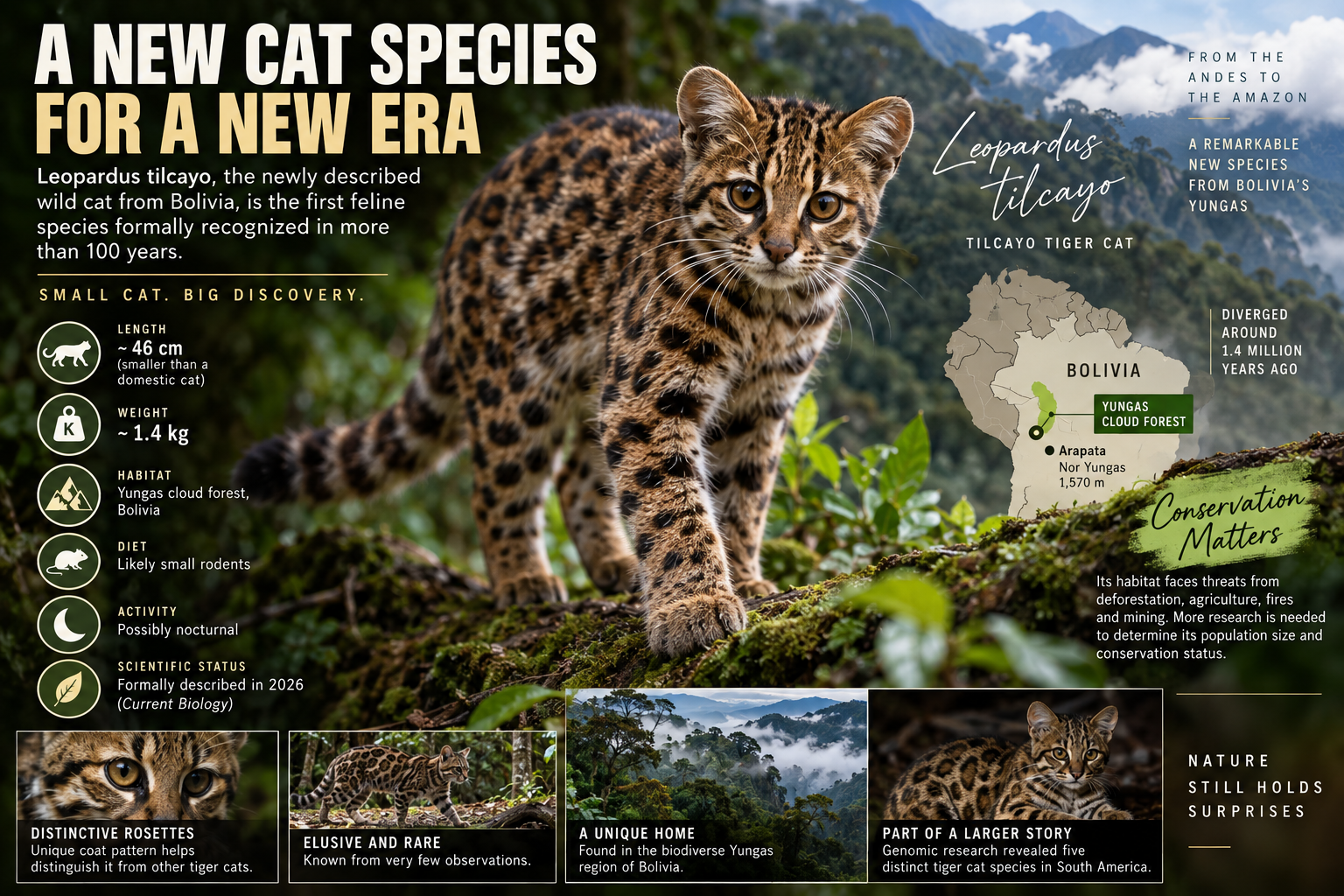
A tiny spotted wild cat hiding in Bolivia's cloud forests has just become one of the most remarkable mammal discoveries in more than a century.
Scientists have formally described a new species called Leopardus tilcayo, commonly known as the tilcayo tiger cat. The animal lives in the mountainous Yungas forests of Bolivia, where the Andes meet the Amazon basin.
Although local communities had known the animal as a "tilcayo" for generations, scientists only recently confirmed that it represents a distinct species. The finding was published in Current Biology on September 17, 2026, following a large genetic study of South American tiger cats.
The discovery is particularly significant because Leopardus tilcayo is the first newly described living cat species in more than 100 years, according to the researchers.
The genetic research found that what scientists had long treated as the South American tiger-cat group actually contains five distinct species, rather than the smaller number previously recognized. The study also identified a new subspecies in Peru.
What Is Leopardus Tilcayo?
Leopardus tilcayo is a small wild feline belonging to the genus Leopardus, the group that includes several of South America's small spotted cats.
It is commonly referred to as the tilcayo or tilcayo tiger cat.
The animal has:
- A light brown coat
- Dark, irregular rosette-like markings
- A relatively slender body
- Rounded ears
- A long, fuller tail compared with some related tiger cats
- A body length of roughly 46 centimeters
- A weight of around 1.4 kilograms
That makes it smaller than an average domestic cat.
Despite its small size, it is a wild predator rather than a feral or domestic cat.
Its appearance helps explain why it remained difficult to distinguish from other tiger cats. These animals are considered cryptic species, meaning closely related species can look remarkably similar while being genetically distinct.
Where Was the New Cat Species Found?
The tilcayo is associated with the Yungas cloud forests of Bolivia.
The Yungas are found along the eastern slopes of the Andes, where high elevations, steep terrain, humidity and cloud-covered forests create an unusually diverse ecosystem.
The type locality for Leopardus tilcayo is near Arapata in Bolivia's Nor Yungas, at roughly 1,570 meters above sea level.
This region is particularly important for biodiversity because it sits within the transition between the Andes and Amazonian ecosystems.
Scientists believe there may be considerably more to discover in the Yungas, especially because many of its forests remain poorly studied.
Why Is It Called Tilcayo?
The name tilcayo did not come from a newly invented scientific term.
It was already being used by local communities to refer to the animal.
Researchers decided to preserve the traditional local name when formally describing the species. The study proposes "tilcayo" as the English common name as well.
National Geographic reported that when researchers asked local people why they called the animal tilcayo, the response was essentially that the name had been passed down through generations.
That makes the name an important part of the story: the animal was not completely unknown to people living in its habitat. It was unknown to formal science as a distinct species.
How Was Leopardus Tilcayo Discovered?
The story began years before the scientific announcement.
In 2016, Bolivian biologist and National Geographic Explorer Paola Nogales-Ascarrunz received a call from a wildlife sanctuary about what staff described as a strange or unusual cat.
The animal had originally been found as a kitten by a local man near a forest road. He reportedly believed it was a domestic cat and took it home.
Eventually, the animal was transferred to the Senda Verde Wildlife Sanctuary in Bolivia.
When researchers examined the cat, its appearance raised questions.
It resembled the tiger cats that scientists already knew, but some characteristics did not seem to match the descriptions of those animals.
That prompted a much deeper investigation.
The DNA Test That Changed Everything
The breakthrough came from genetics.
Researchers analyzed complete genomes from 38 individuals belonging to the Leopardus genus. The sample included wild animals as well as preserved museum specimens from across South and Central America. Eight of the genomes came from museum material.
The researchers compared the genetic data with physical characteristics and evolutionary history.
The results showed that the tiger-cat group was far more diverse than previously understood.
Instead of representing a single species or a smaller number of species, the group contained five genetically distinct species.
One of those five was the previously unrecognized Bolivian lineage that scientists named Leopardus tilcayo.
The Five Tiger Cat Species
The study recognizes five distinct species within the South American tiger-cat complex:
- Leopardus tigrinus
- Leopardus guttulus
- Leopardus pardinoides
- Leopardus emiliae
- Leopardus tilcayo
The first four had previously been proposed as distinct species and were supported by the new genomic analysis. Leopardus tilcayo is the newly described species.
Researchers also described a new subspecies from the Peruvian Yungas:
Leopardus tigrinus antisuyo
The name "antisuyo" refers to Antisuyu, a region of the former Inca Empire associated with the eastern Andes.
How Long Has the Tilcayo Been Separate?
Genetic analysis suggests that the lineage leading to Leopardus tilcayo separated from its relatives approximately 1.4 million years ago.
That means this isn't simply a population of tiger cats that recently developed a slightly different appearance.
The lineage has been evolving separately for a very long period of time.
The genetic distance, combined with differences in appearance and geographic distribution, helped researchers establish that the Bolivian animal should be recognized as its own species.
What Does the Tilcayo Tiger Cat Look Like?
At first glance, the tilcayo looks somewhat like a miniature leopard.
Its body is covered in a light-brown coat marked by dark, irregular rosettes.
The markings are one of the features that helped researchers distinguish it from related tiger cats.
According to the taxonomic description, the tilcayo has more expanded and irregular open rosettes, shorter fur and a less bushy tail than Leopardus pardinoides. It also has larger and more irregular flank markings than Leopardus tigrinus.
Its size makes it particularly striking.
At around 46 centimeters in body length and roughly 1.4 kilograms, the animal is smaller than most domestic cats.
Is the Tilcayo a Tiger?
No.
Despite names such as "tilcayo tiger cat" or "tiger cat," this animal is a small wild feline.
It is not related to the large tiger in the way that the name might suggest.
"Tiger cat" is a common name used for several small spotted cats in the Leopardus group.
The tilcayo is therefore much closer in size and evolutionary context to other small South American wild cats than to a tiger.
What Does the Tilcayo Eat?
Scientists still know very little about the species' everyday behavior.
However, preliminary evidence provides some clues.
Researchers found remains of small rodents in fecal samples, suggesting that rodents may form part of the tilcayo's diet.
Camera-trap observations also indicate that the species may be primarily nocturnal, although researchers emphasize that much more fieldwork is needed before its behavior can be properly understood.
Scientists do not yet have a complete picture of:
- Its full diet
- Its breeding behavior
- Its population size
- Its territory
- Its predators
- Its reproductive rate
- Its complete geographic range
That lack of information is one of the biggest challenges following the discovery.
How Many Leopardus Tilcayo Cats Are There?
This is one of the biggest unanswered questions.
Researchers currently have very limited information about wild tilcayo populations.
The available evidence includes only a small number of live individuals examined by scientists and a relatively small number of camera-trap records.
One known living specimen is a male that currently resides at the Senda Verde Wildlife Sanctuary.
That means scientists cannot yet give a reliable estimate of how many tilcayo cats exist in the wild.
It also means the species could potentially be much rarer than its recent scientific discovery might suggest.
Is Leopardus Tilcayo Endangered?
There is no separate IUCN Red List assessment for Leopardus tilcayo yet.
That distinction is important.
The species has only just been formally described, so conservation organizations now need to determine its population size, distribution and threats before assigning an individual conservation category.
Researchers have shared their findings with the International Union for Conservation of Nature (IUCN) for future assessment.
The situation is potentially concerning because the tilcayo's habitat is under pressure.
Threats Facing the Bolivian Yungas
The Yungas forests face several environmental pressures, including:
- Deforestation
- Agricultural expansion
- Human-caused fires
- Mining
- Habitat fragmentation
- Wildlife trafficking
These threats are particularly important for small wild cats because a newly recognized species can have a much smaller geographic range than scientists previously assumed.
When several animals previously classified together are separated into individual species, conservation assessments may also change.
A population once considered part of a relatively widespread species may turn out to represent a much smaller and more vulnerable lineage.
Why the Discovery Matters for Conservation
The discovery of Leopardus tilcayo is not just about adding another animal to a list.
It changes how scientists understand the distribution and conservation needs of South America's tiger cats.
Before the genomic study, populations from different parts of South America could be grouped together under broader species classifications.
Now that scientists recognize five distinct species, each lineage needs to be evaluated separately.
For example, if a population previously thought to belong to a widespread tiger-cat species is actually an isolated species with a small range, its conservation status could be considerably more serious.
Researchers therefore hope that the new classification will lead to more targeted conservation efforts.
Why Was a New Cat Species Not Found for More Than 100 Years?
The phrase "new cat species discovered" can be slightly misleading.
The tilcayo was not suddenly found wandering through the forest in 2026.
People in the region already knew about the animal.
Scientists had also encountered a living specimen years earlier.
The breakthrough was recognizing that this particular tiger cat was genetically and evolutionarily distinct enough to constitute a separate species.
This is increasingly common in modern taxonomy.
DNA sequencing can reveal differences that are almost impossible to identify simply by looking at an animal.
In the case of the tilcayo, genomic research helped solve a taxonomic puzzle that had persisted for decades.
What Does "Cryptic Species" Mean?
A cryptic species is a species that is difficult to distinguish from another species based only on physical appearance.
This is especially important for small tiger cats.
Several Leopardus species look remarkably similar.
Their coats can have similar colors and patterns, while their body sizes overlap.
Without genetic analysis, researchers may mistakenly classify different evolutionary lineages as one species.
The tilcayo is an excellent example of how genomic science can uncover hidden biodiversity.
The Role of Museum Specimens
One of the most fascinating parts of the study is that researchers did not rely exclusively on living animals.
They also analyzed DNA from museum specimens.
Eight of the 38 genomes used in the research came from preserved museum material.
This approach, sometimes called museomics, allows scientists to extract genetic information from specimens collected decades or even much longer ago.
Museum collections can therefore become valuable sources of new scientific discoveries long after the animals were originally collected.
In this case, preserved specimens helped researchers compare tiger cats from different geographic regions and reconstruct their evolutionary relationships.
The Tilcayo Was Known Locally Before Scientists Named It
One of the most interesting aspects of the story is the difference between local knowledge and scientific recognition.
People living in the Bolivian Yungas had a name for the animal long before scientists formally described it.
They called it tilcayo.
The scientific team chose to retain that local name rather than replacing it with an unrelated common name.
This gives the discovery a cultural dimension as well as a scientific one.
The species was not necessarily "unknown" in the broadest sense.
It was unknown as a formally recognized species in modern scientific taxonomy.
Where Does the Tilcayo Live?
The species is associated with the Bolivian Yungas cloud forest, a mountainous ecosystem on the eastern side of the Andes.
The landscape is characterized by:
- Steep mountain slopes
- Dense vegetation
- High humidity
- Frequent cloud cover
- Forested valleys
- Strong elevation changes
This environment can make wildlife research difficult.
Small nocturnal cats can move through dense vegetation without being detected, and their low population densities make traditional wildlife surveys challenging.
That may help explain why the tilcayo remained scientifically overlooked.
Could There Be More New Cat Species?
Scientists believe it is possible.
The tilcayo discovery demonstrates that even relatively well-studied mammal groups can contain hidden diversity.
The researchers specifically note that the Yungas and other parts of South America contain poorly studied populations of small wild cats.
Advanced genetic methods may reveal additional differences between populations currently grouped together.
However, that does not mean that scientists expect a large number of undiscovered large cat species.
New mammal species are relatively rare, and the tilcayo's discovery is extraordinary precisely because formal descriptions of new living feline species are so uncommon.
Leopardus Tilcayo vs. a Domestic Cat
Feature Leopardus tilcayo Domestic cat Type Wild feline Domesticated feline Genus Leopardus Felis Location Bolivian Yungas Worldwide Approx. body length 46 cm Variable Approx. weight 1.4 kg Usually considerably heavier Coat Light brown with dark rosettes Highly variable Lifestyle Wild, likely nocturnal Domestic Diet Likely small prey including rodents Domestic food and small prey Habitat Yungas cloud forest Human-associated environments Scientific status Newly described in 2026 Long-established speciesLeopardus Tilcayo: Key Facts
Fact Details Scientific name Leopardus tilcayo Common name Tilcayo / tilcayo tiger cat Family Felidae Genus Leopardus Country Bolivia Region Yungas Habitat Cloud forest Length About 46 cm Weight About 1.4 kg Activity Possibly primarily nocturnal Known prey Small rodents among suspected prey Lineage divergence About 1.4 million years ago Formal description 2026 Research journal Current Biology IUCN status Not yet separately assessedWhat Happens Next for the Tilcayo?
The next stage of research will be just as important as the discovery itself.
Scientists need to determine:
- How many tilcayos are in the wild?
- How large is their range?
- Are they found only in Bolivia?
- What habitats do they require?
- How frequently do they reproduce?
- What threats are affecting their populations?
Researchers are already using or planning additional camera-trap work to find wild individuals and better understand the species.
Those observations could eventually provide the information needed for a formal conservation assessment.
Why This New Cat Species Is a Big Deal
The story of Leopardus tilcayo is a reminder that discovering new species doesn't always require finding an animal no human has ever seen.
Sometimes the animal is right in front of us—but science hasn't yet understood what it is.
The tilcayo had been known by local communities. A specimen had been living at a wildlife sanctuary. Researchers had even examined the animal years ago.
It took modern genomic analysis to reveal that the small spotted cat represented a distinct evolutionary lineage.
And the discovery did more than create one new species name.
It showed that South America's tiger cats comprise five distinct species, fundamentally changing scientists' understanding of this group.
For Bolivia, it is a remarkable addition to the country's known biodiversity.
For conservationists, it is a warning that species can remain hidden in plain sight—and that protecting their habitats may become urgent before scientists even have a complete picture of how many animals remain.
Frequently Asked Questions About the New Cat Species
What is the new cat species discovered in 2026?
The new cat species is Leopardus tilcayo, commonly called the tilcayo or tilcayo tiger cat. It lives in Bolivia's Yungas cloud forests and was formally described in Current Biology in September 2026.
Where was the new cat species discovered?
Leopardus tilcayo was identified in the Yungas region of Bolivia, on the eastern slopes of the Andes. The type locality is near Arapata in Nor Yungas.
Is Leopardus tilcayo a real new species?
Yes. Researchers formally described Leopardus tilcayo as a new species after comparing genomic data and physical characteristics with other tiger cats.
Is the tilcayo a tiger cat?
Yes. It belongs to the group commonly called tiger cats, a collection of small spotted wild cats in the genus Leopardus.
How big is the tilcayo tiger cat?
The tilcayo is approximately 46 centimeters long and weighs around 1.4 kilograms, making it smaller than the average domestic cat.
What does Leopardus tilcayo look like?
It has a light-brown coat with irregular dark rosettes and a slender body. Its markings and tail characteristics help distinguish it from related tiger-cat species.
How was Leopardus tilcayo identified?
Scientists compared the complete genomes of 38 Leopardus individuals from across Central and South America, including museum specimens. The genetic evidence showed that the Bolivian lineage was distinct from the other tiger cats.
Why is the tilcayo discovery important?
It is the first newly described living cat species in more than a century and also reveals that the South American tiger-cat group contains five distinct species.
Is Leopardus tilcayo endangered?
Its individual IUCN conservation status has not yet been determined. Researchers have shared the findings with the IUCN so the newly separated lineages can be assessed individually.
Are there many tilcayo cats?
Scientists do not yet know. Available information is extremely limited, with only a small number of confirmed observations and very little data about the species' wild population.
When was the new species officially announced?
The scientific study describing Leopardus tilcayo was published in Current Biology on September 17, 2026.
Final Takeaway
The new cat species discovered in Bolivia in 2026 is Leopardus tilcayo, a tiny spotted wild cat from the country's Yungas cloud forests.
It weighs only around 1.4 kilograms, yet its scientific importance is enormous.
The species had been known locally as tilcayo, but genomic research finally revealed that it was not simply another population of an already recognized tiger cat.
Instead, it represents a distinct evolutionary lineage that separated from its relatives roughly 1.4 million years ago.
The discovery also rewrites part of the tiger-cat family tree, showing that the group contains five distinct species and one newly recognized subspecies.
Most importantly, the discovery comes with a conservation message. Scientists still don't know how many tilcayos survive in the wild or exactly how large their range is, while the Yungas forests face pressure from deforestation, agriculture, fires and mining.
The tiny tilcayo tiger cat may therefore be a new species to science—but protecting the forest it calls home could determine how long it remains part of the living world.