
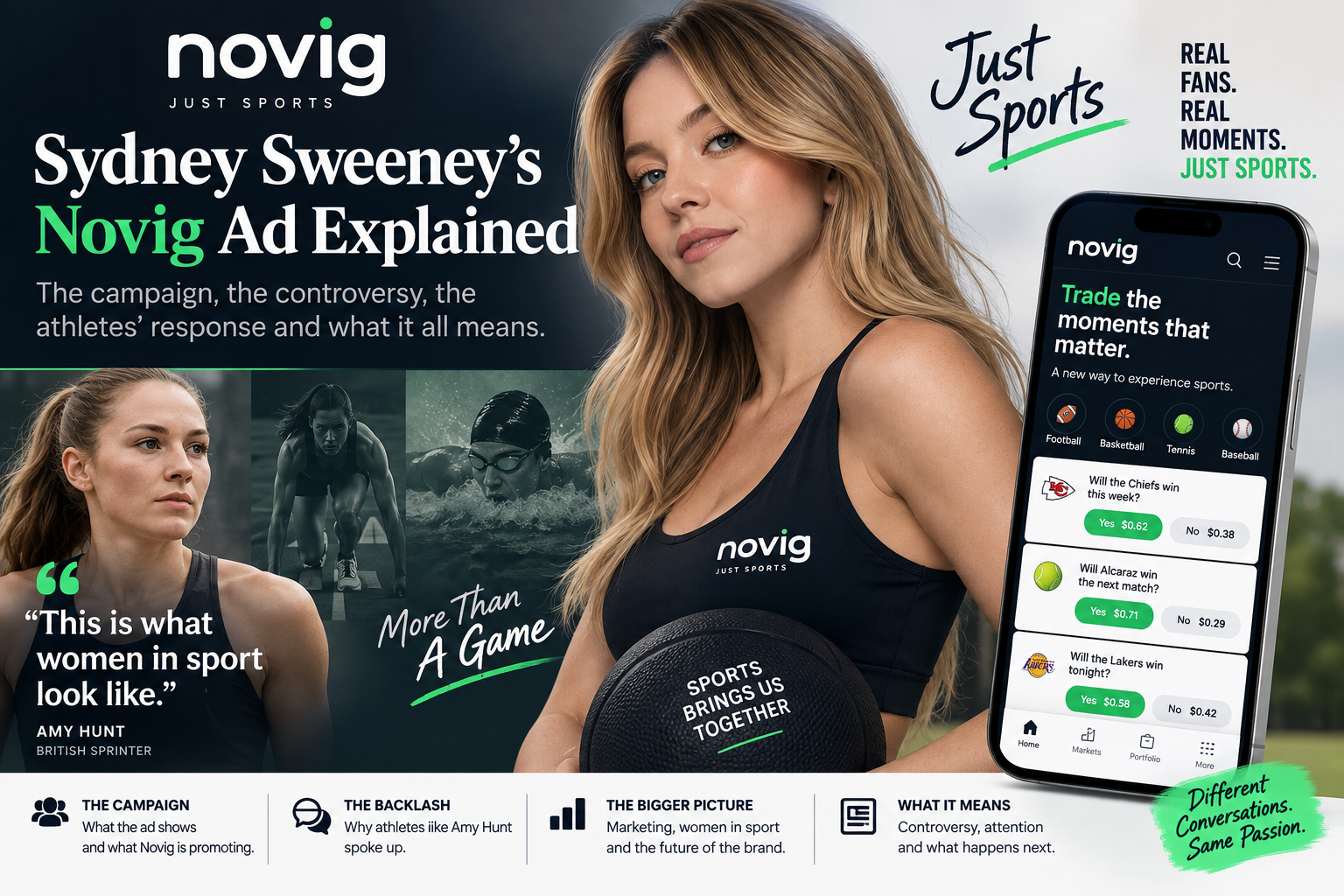
The Euphoria star has become the face of Novig’s new “Just Sports” campaign, a provocative advertisement for the sports prediction market that has quickly gone viral.
The commercial features Sweeney with little or no clothing while sports equipment is used to cover parts of her body. She moves through scenes involving basketball, football, tennis, hockey, baseball and other sports while repeatedly emphasizing the word “sports.”
The campaign was designed to make people look twice.
It succeeded.
But it also triggered a wave of criticism from female athletes, including British sprinter Amy Hunt and Olympic swimming champion Ariarne Titmus, who argue that the campaign reduces women in sport to their appearance rather than celebrating their athletic ability.
At the same time, Novig has received enormous exposure from the controversy, raising a very different question:
Did the ad fail because people hated it, or did it succeed because everyone is talking about it?
The answer is more complicated than either side suggests.
What is the Sydney Sweeney Novig ad?
The campaign, titled “Just Sports,” launched on September 9, 2026.
In the roughly one-minute commercial, Sweeney presents Novig as a platform focused specifically on sports. The advertisement uses a series of provocative sports-themed images, with Sweeney posing alongside equipment associated with different games.
The basic marketing message is that Novig is about sports rather than political or other prediction markets.
The commercial ends with Sweeney continuing the deliberately playful tone of the campaign.
Novig describes itself as a sports prediction market rather than a traditional sportsbook. Its own help center says users trade event contracts tied to sporting outcomes, with contract values moving between $0 and $1 and settling according to the eventual result.
That distinction is important because the company operates within the U.S. federal prediction-market framework.
There is more to this partnership than a conventional celebrity endorsement.
Sweeney joined Novig as a strategic partner and equity holder, meaning she owns a stake in the company.
According to an interview with Complex, Sweeney said she was involved in the creative discussions from the beginning and wanted to participate in the business rather than simply appear in front of a camera. She described the concept behind the campaign as simple and playful and said she wanted to help bring the “just sports” idea to life.
The financial details of her stake have not been publicly disclosed.
That makes the campaign more interesting from a business perspective.
Sweeney isn't simply saying:
“Try this product.”
She has a financial interest in the company she is helping promote.
That potentially gives her a much deeper connection to the campaign's success than a standard celebrity endorsement.
This is where the story gets slightly more technical.
Novig calls itself a CFTC-regulated sports prediction market.
Rather than describing its product as a traditional sportsbook, Novig says users buy and sell event contracts whose value is tied to sporting outcomes.
For example, a contract could relate to whether a particular team wins a game.
Novig explains that contracts trade between $0 and $1 and can be bought or sold before the event is settled.
In June 2026, Novig announced that it had received designation from the U.S. Commodity Futures Trading Commission (CFTC) as a Designated Contract Market. The company subsequently announced its nationwide launch on August 4.
The CFTC has separately acknowledged the rapid growth of prediction markets and issued guidance in March 2026 addressing regulatory considerations surrounding event contracts, including sports-related contracts.
So when people call Novig a “sports betting app,” there is an important technical distinction: Novig itself says it operates as a federally regulated prediction-market exchange rather than a conventional sportsbook.
The central criticism isn't simply that Sweeney appears nude.
The bigger issue raised by female athletes is context.
Critics argue that the campaign uses a sexualized image of a woman to sell a product associated with sports, at a time when women's athletics has spent years trying to shift attention toward performance, skill and achievement.
The argument goes something like this:
Women athletes train for years to be recognized for what they can do.
The Novig campaign, critics say, puts the emphasis back on what a woman's body looks like.
That criticism has come from athletes across different sports.
Australian Olympic swimmer Ariarne Titmus called the campaign deeply frustrating and argued that it was disrespectful to women who dedicate their lives to athletic performance. Other athletes have posted images and videos of their own training and competition as a contrast to the advertisement.
British sprinter Amy Hunt also joined the criticism.
Amy Hunt became one of the most visible athletes to respond.
After competing in the 200-meter final at the World Athletics Ultimate Championship in Budapest, Hunt was asked about the controversy.
She used the moment to contrast the advertisement with the reality of competitive sport.
Hunt's response centered on the physical effort and dedication required from women athletes and was widely reported with the message:
“Sydney Sweeney, this is what women in sport look like.”
Hunt had just run a season-best 22.10 seconds in the 200m final.
That timing gave her response particular weight.
Rather than commenting from outside the sporting world, she was speaking immediately after competing at an elite international event.
Her criticism also helped shift the online conversation away from Sweeney as an individual and toward a broader question about how women athletes are represented.
Hunt was far from alone.
Olympic swimmer Ariarne Titmus, gymnast Gracie Kramer, cyclist Sophie Capewell, boxer Skye Nicolson and other athletes have criticized the campaign.
Gracie Kramer was among the athletes who responded by highlighting what actual women's sport looks like: competition, training, physical effort and performance.
Sophie Capewell and other cyclists made a similar argument, saying women should be recognized for what they can accomplish rather than primarily for their appearance.
The criticism therefore became bigger than one advertisement.
It turned into a debate about the representation of women in sports media.
Sweeney did not issue a lengthy public statement attacking the criticism.
Instead, she posted images from ESPN's well-known Body Issue, which has featured nude or minimally clothed professional athletes.
Those images included prominent athletes such as Serena Williams and other sports stars.
The apparent point was that athletic bodies have previously been celebrated through artistic or editorial photography, even when the subjects were nude.
ABC News and other outlets reported on Sweeney's response as the controversy developed.
But critics have argued that there is a meaningful difference between an athlete participating in an editorial project about their body and a celebrity appearing in a commercial designed to sell a financial or sports product.
That distinction is at the heart of much of the disagreement.
Not entirely.
That's one of the easiest parts of the story to misunderstand.
Women have posed nude for magazines, art projects, documentaries and sports campaigns for decades.
The criticism surrounding the Novig advertisement is more specifically about why the image is being used and what it is selling.
A nude image in an editorial celebrating athletic bodies can communicate one thing.
A sexualized image used to attract attention to a sports prediction product can communicate something very different.
Critics say the Novig campaign falls into the second category.
Supporters can argue that Sweeney is an adult making her own choices and that the campaign deliberately uses humor, confidence and provocation as part of its creative concept.
Those are two different interpretations of the same advertisement.
The marketing strategy is fairly obvious: attention.
Novig entered an increasingly crowded prediction-market industry.
It competes for attention with larger and better-known platforms, while the wider prediction-market sector is becoming increasingly visible in the United States.
A conventional advertisement explaining how event contracts work might be informative.
It might also be forgettable.
A controversial advertisement featuring one of Hollywood's most recognizable young actors is almost impossible to ignore.
Within days, the Novig campaign was being discussed by:
- Sports media
- Entertainment websites
- Female athletes
- Australian broadcasters
- U.S. media
- Social media creators
- Advertising commentators
- Sweeney's existing fan base
That exposure is extremely difficult to buy through conventional advertising alone.
The numbers have moved rapidly as the campaign has spread.
ABC reported that the advertisement had been viewed more than 33 million times at the time of its September 14 report. Other reporting subsequently put the campaign's Instagram views above 40 million.
Sweeney's own Instagram post also attracted more than 1 million likes, according to reporting citing social-media data.
At the same time, Social Blade data reported by several outlets showed Sweeney losing more than 200,000 Instagram followers after the controversy intensified.
Those numbers illustrate something important about viral advertising:
Attention and approval are not the same metric.
A campaign can generate enormous reach while simultaneously angering part of its audience.
Reports indicate that she did.
Social Blade data cited by entertainment media showed a sharp decline in followers after the campaign's release, with more than 200,000 accounts reportedly unfollowing her over several days.
But follower loss should be interpreted carefully.
It does not automatically tell us:
- How many people became customers of Novig
- How many people downloaded the app
- Whether the campaign improved long-term brand awareness
- Whether the controversy increased revenue
- Whether previous followers were inactive
- Whether new followers replaced some of those who left
Those are different business metrics.
This is where the story gets particularly interesting.
From a brand-awareness perspective, the campaign clearly generated extraordinary attention.
Before the advertisement, many people outside the prediction-market industry may not have known Novig existed.
After the advertisement, the company's name appeared in international headlines alongside Sydney Sweeney.
Business Insider reported that Novig's social-media mentions increased substantially following the campaign and that positive social posts outnumbered negative ones in the analysis it cited.
But there is an important caveat.
Virality is not the same as customer acquisition.
Millions of people watching an advertisement doesn't necessarily mean millions of people signing up.
The real test for Novig will be what happens after the controversy fades.
Does awareness turn into:
Views → Website visits → Sign-ups → Deposits/trading → Retention?
That is the marketing funnel that ultimately determines whether the campaign delivered business value.
The campaign arrived as the U.S. football season was getting underway.
That is strategically important.
Sports prediction companies are competing for consumer attention during one of the busiest periods of the American sports calendar.
Novig's own positioning is deliberately narrow: sports.
The campaign reinforces that identity repeatedly.
The company isn't trying to explain every possible use of prediction markets.
It wants people to associate the brand with sports.
Sweeney's celebrity recognition gives that positioning a huge distribution advantage.
There is another reason this campaign matters.
Novig is not a tiny experimental website anymore.
The company announced a $75 million Series B funding round in February 2026, according to its published company announcements.
The company also received CFTC designation and launched nationwide in August.
That means the Sweeney campaign arrives at an important stage in Novig's development.
The company is trying to establish itself as a recognizable national consumer brand.
And Sweeney isn't simply providing celebrity recognition.
She has an ownership interest.
That makes the campaign part advertising stunt, part celebrity partnership and part business strategy.
The slogan is central to understanding the campaign.
Novig wants to differentiate itself from broader prediction-market platforms that offer contracts relating to subjects beyond sports.
The Sweeney advertisement repeatedly emphasizes sports and presents the platform as focused on sporting outcomes.
The campaign also contrasts sports with areas such as politics and other controversial prediction categories.
In other words, the provocative visuals are wrapped around a relatively straightforward positioning strategy:
Novig = sports prediction markets.
The creative execution is what made that message controversial.
Sweeney has become a lightning rod for advertising controversies.
Her 2025 American Eagle campaign also generated significant online debate.
That history matters because audiences now recognize a pattern: Sweeney is willing to participate in campaigns that deliberately generate strong reactions.
The Novig campaign appears to continue that approach.
But this time, the backlash has come particularly strongly from women who actually compete in sports.
That changes the conversation.
It isn't simply:
“Do you like Sydney Sweeney's advertisement?”
The debate has become:
“How should women be represented when sports and commercial advertising intersect?”
This is probably the most important question raised by the campaign.
One side emphasizes agency.
Sweeney is an adult. She chose to participate. She helped shape the campaign. She reportedly wanted an equity relationship rather than simply being a spokesperson.
From that perspective, choosing to use sexuality in advertising can be a form of personal and professional control.
The other side focuses on representation.
Critics argue that individual choice doesn't remove the broader cultural effect of repeatedly presenting women primarily through sexual imagery, particularly when the advertisement is attached to the world of women's sports.
Both arguments can exist simultaneously.
A person can have agency over their own image while audiences can still debate what a particular advertising campaign communicates about women more broadly.
Amy Hunt's response became one of the most memorable moments of the controversy because it offered an immediate visual contrast.
The Novig advertisement showed an actress using sports equipment as props.
Hunt had just finished a 200-meter final.
Her response effectively put performance next to advertising.
That distinction explains why the backlash gained momentum among athletes.
The conversation was no longer only about whether the ad was sexy or provocative.
It became about what viewers think a woman in sport should represent.
That depends on the definition being used.
Critics, including athletes and women's-sport advocates, have described the campaign as sexualizing or objectifying women in sport. ABC, AP and other outlets have reported those criticisms.
Novig and Sweeney have presented the campaign differently, describing it as playful and focused on the company's sports-only positioning.
Rather than treating the label as an objective fact, the concrete disagreement is easier to understand:
Critics see the campaign as using a woman's sexuality to sell a sports product.
Sweeney and the campaign's creators frame it as deliberate humor, confidence and creative provocation.
The advertisement itself is not ambiguous about being provocative.
The disagreement is about what that provocation means.
The athletes' response developed its own social-media format.
Instead of simply criticizing Sweeney, several athletes posted footage of themselves competing, training or performing.
The message was essentially:
This is what women's sport looks like.
That created a second campaign alongside Novig's campaign.
Novig had sports equipment, glamour and celebrity.
The athletes had sweat, competition and performance.
That contrast made the story visually powerful and helped it travel across social media.
There is a larger lesson here for advertisers.
Traditional celebrity advertising often follows a simple formula:
Celebrity + Product = Attention
The Novig campaign pushes that formula further:
Celebrity + controversy + ownership + social media = attention at scale
Sweeney's equity position makes the partnership particularly unusual.
She has a reason to care about the company's growth.
She also has creative involvement.
And the controversy itself has become part of the campaign's distribution.
Whether that ultimately produces sustainable business results remains to be seen.
What is the Sydney Sweeney Novig ad?
It is a 2026 advertising campaign called “Just Sports” for Novig, a CFTC-regulated sports prediction market. The campaign features Sweeney in provocative sports-themed scenes involving equipment from multiple sports.
Why is Sydney Sweeney's Novig ad controversial?
Female athletes and other critics argue that the advertisement sexualizes women in sports and shifts attention away from athletic ability and achievement. Sweeney and the campaign's creators have described the concept as playful and focused on sports.
Who is Amy Hunt?
Amy Hunt is a British sprinter and European champion who competed in the 200 meters at the 2026 World Athletics Ultimate Championship. She publicly criticized the Sydney Sweeney Novig advertisement after her race in Budapest.
What did Amy Hunt say about Sydney Sweeney?
Hunt used her post-race interview to contrast the advertisement with the reality of elite women's athletics, saying, “Sydney Sweeney, this is what women in sport look like.”
Is Novig a sportsbook?
Novig says it is not a traditional sportsbook. It describes itself as a CFTC-regulated prediction market where users trade event contracts tied to sports outcomes.
Is Novig legal in the United States?
Novig announced that it received CFTC designation as a Designated Contract Market in June 2026 and subsequently launched nationwide in August.
Does Sydney Sweeney own Novig?
Sweeney is a strategic partner and equity holder in Novig. The size and financial terms of her ownership stake have not been publicly disclosed.
Did Sydney Sweeney lose Instagram followers because of the ad?
Reports citing Social Blade data said Sweeney lost more than 200,000 Instagram followers in the days following the campaign's release. Her post promoting the campaign nevertheless received more than 1 million likes.
How many people watched the Sydney Sweeney Novig ad?
The campaign accumulated tens of millions of views across social platforms. ABC reported more than 33 million views by September 14, while subsequent reports put Instagram views above 40 million.
What is the “Just Sports” campaign?
“Just Sports” is Novig's campaign positioning the company as a prediction market focused specifically on sports. Sweeney helped shape the campaign's creative direction and appears as its central figure.
The Sydney Sweeney–Novig controversy is not simply another celebrity advertising scandal.
It sits at the intersection of Hollywood, sports, women's representation, prediction markets, social-media marketing and celebrity ownership.
The advertisement was designed to be noticed, and it certainly achieved that.
But the response shows the risk that comes with deliberately provocative advertising: once a campaign becomes part of a cultural conversation, the brand no longer controls the meaning.
For Novig, the immediate result is extraordinary awareness.
For Sweeney, it is another example of how her willingness to participate in provocative advertising can generate both attention and criticism.
For women athletes, the campaign has opened a familiar debate about whether women in sport are being recognized for their performance or still being asked to compete for attention based on appearance.
And for marketers, there may be an even simpler lesson:
Going viral can be measured in views. Whether going viral was actually good for the business takes much longer to measure.
The real story of the Sydney Sweeney Novig ad may therefore not be how many people watched it.
It may be what happens after everyone stops talking about it.