
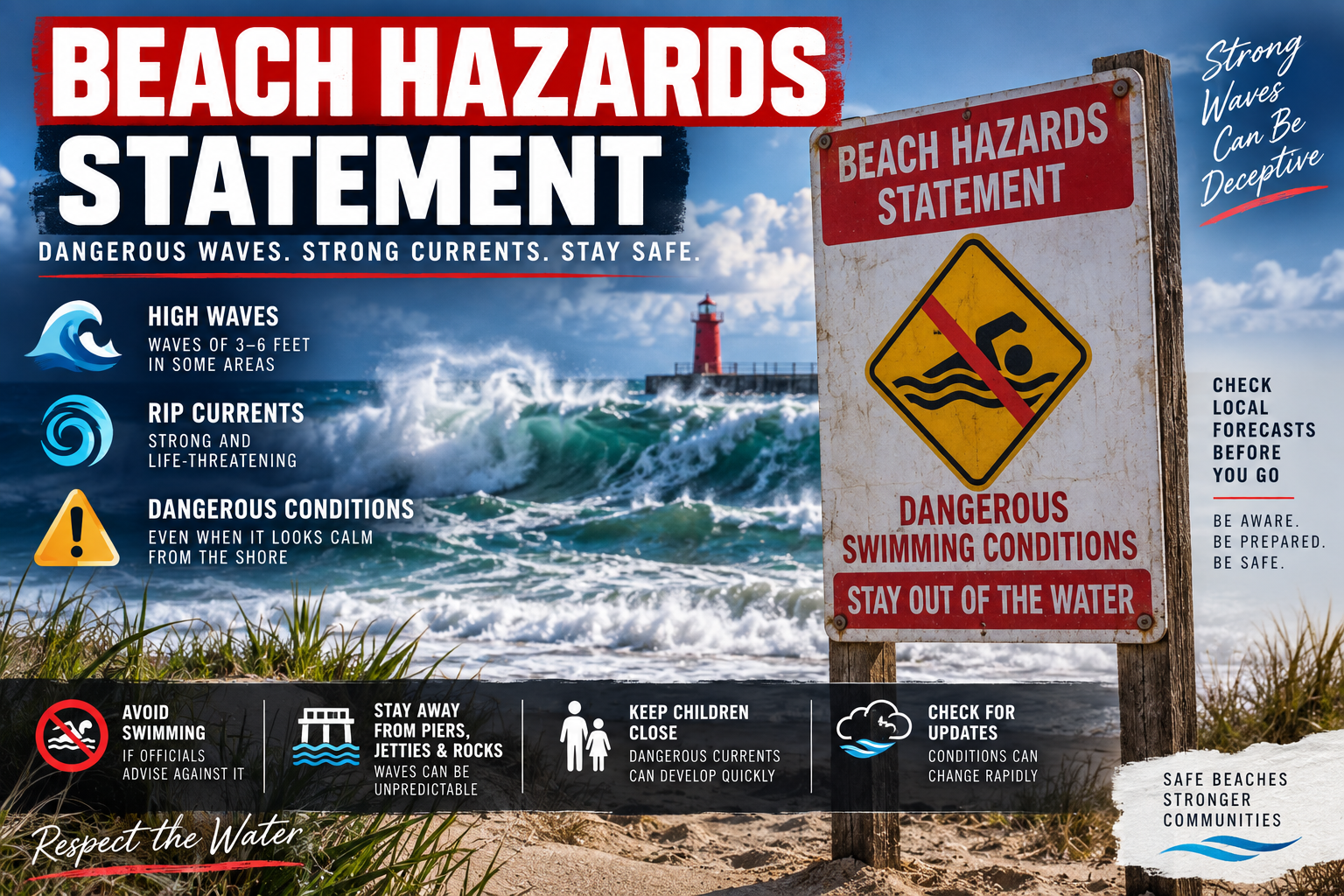
A day at the beach can look perfectly calm from the shoreline, yet conditions in the water can change quickly.
That is why the words “Beach Hazards Statement” are getting attention in weather alerts right now. The National Weather Service is warning of dangerous swimming conditions in several areas, including beaches along Lake Michigan and Lake Superior.
On Friday, September 18, 2026, the National Weather Service reported high wave action and dangerous currents along parts of Lake Michigan, with waves reaching 3 to 6 feet. A separate statement for beaches around Minnesota's Park Point and Wisconsin Point warned of dangerous swimming conditions caused by high waves and strong rip currents.
For anyone planning to swim, walk along a pier or spend time near the shoreline, the alert is more than just another weather notification. It is a signal that normal beach activities may become dangerous.
What Is a Beach Hazards Statement?
A Beach Hazards Statement is issued by the National Weather Service when hazardous conditions are expected in or around the surf zone.
Depending on the location, the threat can come from rip currents, longshore currents, powerful waves, sneaker waves, rough surf or other dangerous shoreline conditions.
The exact danger varies from beach to beach. A warning about strong rip currents on one coastline may look different from an alert about large waves and dangerous currents along a Great Lakes beach.
The important point is simple: the water may be unsafe even when the weather above the water does not look particularly severe.
Why Is the Beach Hazards Statement Trending Now?
The term has drawn attention because multiple National Weather Service offices have issued beach-related alerts during the current weather pattern.
In the Chicago area, the National Weather Service issued a Beach Hazards Statement for Lake Michigan beaches in Lake, Northern Cook and Central Cook counties. Officials reported waves of 3 to 6 feet and dangerous currents, warning that swimming conditions could be life-threatening, particularly for inexperienced swimmers.
The Chicago forecast also indicated that another period of dangerous swimming conditions could develop later Friday night and continue into early next week.
Farther north, the National Weather Service Duluth office issued a Beach Hazards Statement for Minnesota Park Point and Wisconsin Point. That alert called for dangerous swimming conditions from high wave action and strong rip currents.
Milwaukee, Racine and Kenosha were also under a Beach Hazards Statement Friday, with life-threatening waves of 3 to 4 feet and dangerous currents expected because of high waves and onshore winds.
Where Are the Current Beach Hazards?
Area Current Concern Reported Conditions Lake Michigan – Chicago area High waves and dangerous currents 3–6 ft waves in some areas Lake Michigan – Milwaukee/Racine/Kenosha Dangerous currents and waves 3–4 ft life-threatening waves Lake Superior – Park Point/Wisconsin Point Strong rip currents and high wave action High swimming riskThese conditions are location-specific and can change quickly. Beachgoers should check the latest local National Weather Service forecast before entering the water rather than relying on a general regional forecast.
What Makes These Beach Conditions Dangerous?
The biggest problem is that dangerous water does not always look dangerous.
Someone standing on the shore may see waves that appear manageable. But beneath the surface, currents can move much faster and with considerably more force than an inexperienced swimmer expects.
Several different hazards can be responsible for a Beach Hazards Statement.
Rip Currents
Rip currents are narrow, powerful channels of water moving away from shore.
They can pull swimmers away from the beach surprisingly quickly. One of the most important misconceptions is that a strong swimmer can simply fight the current and swim directly back to shore.
That approach can exhaust a swimmer.
If caught in a rip current, the general safety advice is to remain calm and avoid trying to overpower the current by swimming straight toward the beach. Swimmers should follow local lifeguard and emergency guidance and, where appropriate, swim parallel to the shoreline until they are out of the current before heading back toward shore.
Longshore Currents
Longshore currents move along the shoreline rather than directly away from it.
They can push swimmers or surfers sideways and toward structures such as piers, jetties and breakwalls.
National Weather Service warnings have specifically highlighted strong longshore currents as a reason for dangerous beach conditions in previous alerts.
Large and Breaking Waves
Waves do not need to be enormous to become dangerous.
A combination of wave height, wind direction, wave period, shoreline shape and currents can create difficult swimming conditions.
For example, the latest Chicago-area forecast called for waves of 3 to 6 feet at some Lake Michigan beaches, with a high swim risk.
Sneaker Waves
Sneaker waves are particularly deceptive because they can arrive unexpectedly after a period of smaller waves.
They can surge much farther up the beach than people anticipate, potentially knocking someone off their feet or sweeping them into deeper water.
This has been an important concern along parts of the Pacific Coast during previous Beach Hazards Statements this year. The National Weather Service has warned that sneaker waves can catch beachgoers by surprise, particularly around rocks, jetties and other shoreline structures.
Why Piers, Jetties and Breakwalls Can Be Especially Dangerous
When a beach is under a hazard statement, people sometimes make the mistake of thinking that staying out of the water is enough.
It isn't always.
Strong waves and currents can make structures extending into the water dangerous even for people who are not swimming.
The National Weather Service is specifically advising people to stay away from piers, breakwalls and similar shoreline structures during the current Lake Michigan hazards.
A wave can strike a structure, knock someone off balance and send them into the water. Rocks can also become extremely slippery when waves repeatedly wash over them.
In hazardous conditions, the safest option is to watch the water from a secure location away from the edge.
Is It Safe to Swim During a Beach Hazards Statement?
People should avoid entering the water when the local Beach Hazards Statement advises staying out.
The current Chicago-area statement explicitly says to remain out of the water because of dangerous swimming conditions. The National Weather Service also advises people to avoid piers, jetties, breakwalls and other shoreline structures.
The same basic message applies to the current Park Point and Wisconsin Point alert, where officials are warning of life-threatening waves and rip currents.
This is especially important for children, inexperienced swimmers and anyone unfamiliar with the local water conditions.
What Should You Do If You Are Already at the Beach?
If a Beach Hazards Statement is issued while you are at the beach, don't wait for conditions to become obviously dangerous.
- Stay out of the water if officials advise against swimming.
- Move away from piers, jetties, rocks and breakwalls.
- Stay near occupied lifeguard areas when beaches are open and swimming is permitted.
- Keep children away from the water's edge.
- Do not assume calm-looking water is safe.
- Check the latest local weather and beach forecast.
- Follow instructions from lifeguards and local authorities.
The National Weather Service's Chicago office specifically recommends staying out of the water and away from dangerous shoreline structures during the current advisory.
What If You Get Caught in a Rip Current?
The first thing is to avoid panic.
Trying to swim directly against a powerful current can quickly lead to exhaustion. Instead, swimmers should try to stay afloat and follow established rip-current safety guidance, including swimming parallel to the shoreline when conditions allow and calling for help if necessary.
If you cannot escape the current, signal for assistance and conserve your energy while waiting for help.
Most importantly, do not enter dangerous water simply because another person appears to be struggling. A rescuer can quickly become a second victim.
Beach Hazards Statement vs. Rip Current Statement
These terms are related, but they are not necessarily identical.
A Beach Hazards Statement can cover several types of hazards affecting the beach and surf zone, including rip currents, longshore currents and sneaker waves.
A local National Weather Service office determines what hazard is occurring and how the alert should be communicated based on regional conditions.
That is why one Beach Hazards Statement might mention large waves while another focuses primarily on rip currents.
Does a Beach Hazards Statement Mean the Beach Is Closed?
Not necessarily.
A Beach Hazards Statement is a weather-related hazard alert. It does not automatically mean every beach in the affected area has been physically closed.
However, if local authorities or lifeguards close a beach or prohibit swimming, that instruction should be followed immediately.
Even where a beach remains accessible, the presence of a Beach Hazards Statement means conditions may be significantly more dangerous than normal.
Why Great Lakes Beaches Can Become Dangerous
It is easy to associate dangerous surf only with ocean beaches.
But the Great Lakes can produce serious waves and powerful currents, particularly when strong winds push water across large stretches of open lake.
Friday's Lake Michigan forecast demonstrates this clearly. The National Weather Service reported high swimming risk and waves reaching 3 to 6 feet in parts of the lake, with additional building of wave heights possible overnight.
The combination of wind, wave action and currents can create conditions that are dangerous for swimmers even though the location is technically a freshwater lake rather than an ocean beach.
Beach Hazards Can Change Quickly
One reason weather officials encourage people to check conditions immediately before visiting a beach is that water conditions can change faster than the general weather may suggest.
Winds can strengthen, waves can build and currents can become more powerful.
A beach that was comfortable for swimming earlier in the day may become unsafe later.
That is particularly relevant during the current Great Lakes alerts. Chicago's National Weather Service office is warning of another period of dangerous swimming conditions tonight into early next week.
Beach Safety: The Most Important Rule
The simplest rule is also the one most worth remembering:
If officials are telling you to stay out of the water, stay out of the water.
Experienced swimmers are not immune to rip currents, powerful waves or sudden changes in water conditions. Swimming ability can reduce some risks, but it cannot eliminate the forces created by wind, waves and currents.
And if the beach looks unusually rough, there is little benefit in taking a chance simply for a swim.
Beach Hazards Statement: Frequently Asked Questions
What does a Beach Hazards Statement mean?
A Beach Hazards Statement means the National Weather Service expects hazardous conditions in or around the surf zone. Depending on the location, hazards can include rip currents, longshore currents, sneaker waves and dangerous waves.
Is a Beach Hazards Statement the same as a beach closure?
No. A Beach Hazards Statement is a weather hazard alert and does not automatically mean a beach is closed. Local authorities can separately close beaches or prohibit swimming.
Can you swim during a Beach Hazards Statement?
If the local alert advises people to remain out of the water, swimming should be avoided. Current National Weather Service alerts around portions of Lake Michigan and Lake Superior are advising people to stay out of dangerous water.
What is the biggest danger during a Beach Hazards Statement?
There is no single hazard that applies everywhere. Rip currents, strong waves, longshore currents and sneaker waves can all create dangerous conditions depending on the location.
Can lakes have dangerous beach conditions?
Yes. The Great Lakes can experience powerful waves and currents. Current alerts around Lake Michigan and Lake Superior demonstrate that dangerous swimming conditions are not limited to ocean beaches.
How can I check whether my beach is safe?
Check the latest National Weather Service forecast for your specific area and follow instructions from local lifeguards, beach officials and emergency authorities. Conditions can vary significantly between nearby beaches.
The Bottom Line
A Beach Hazards Statement is not something to ignore simply because the sun is shining or the shoreline looks calm.
Right now, National Weather Service offices are warning of dangerous swimming conditions at several Great Lakes locations. Parts of Lake Michigan are seeing high wave action and dangerous currents, while beaches around Lake Superior are facing strong rip currents and hazardous waves.
The safest approach is straightforward: check the local alert before entering the water, stay away from hazardous shoreline structures and respect lifeguard and weather-service instructions.
A beach day can wait. Dangerous water is not worth the risk.
Editor's note: Beach conditions and official alerts can change rapidly. The information in this article reflects National Weather Service information available on September 18, 2026. Always check the latest local forecast and beach conditions before entering the water.